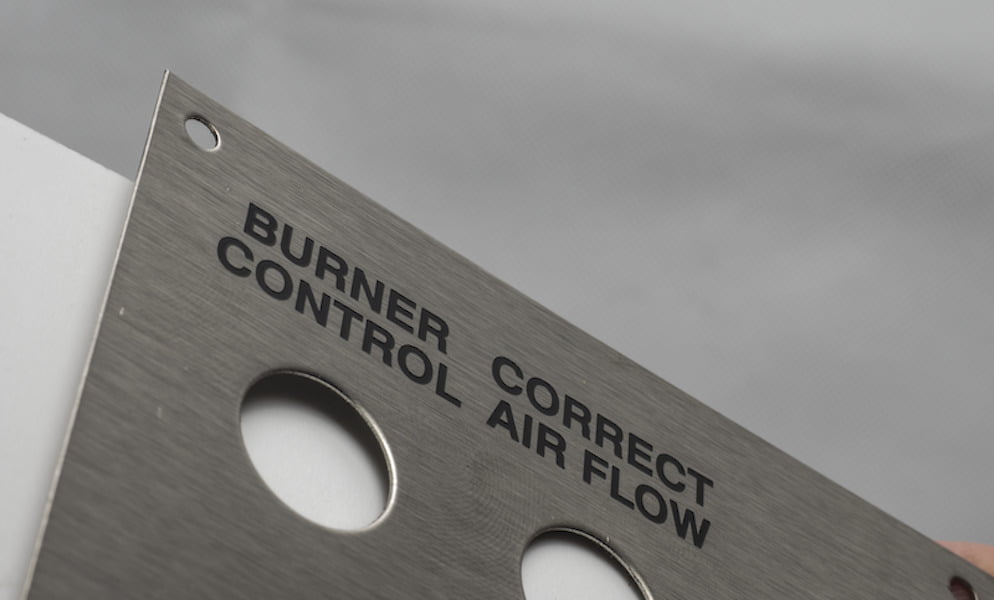
When you are engineering products, infrastructure, or machinery destined for the great outdoors, every single component faces a relentless battle against nature. Ultraviolet (UV) radiation, driving rain, salt spray, extreme temperature swings, and industrial pollutants are constantly working to degrade your equipment.
Among these components, the humble asset tag, serial plate, or branding nameplate carries a massive responsibility. If a nameplate degrades to the point of illegibility, your product loses its branding, its safety compliance, and its critical tracking data.
When it comes to heavy-duty outdoor durability, two metallic champions dominate the market: Anodised Aluminium and Stainless Steel. But which one is the right engineering choice for your specific project?
Let’s break down the science, the strengths, and the ideal use cases for each.
Before pitching them against each other, it helps to understand what makes these metals uniquely resilient.
Aluminium is naturally lightweight and corrosion-resistant, but raw aluminium is too soft for harsh environments. Enter anodisation.
Anodisation is an electrochemical process that converts the metal surface into a decorative, durable, anodic oxide finish. Instead of applying a coating like paint, the protective layer is completely integrated with the underlying aluminium substrate. It creates a porous surface that can swallow high-resolution graphic dyes before being completely sealed shut.
Stainless steel doesn’t rely on an artificial layer for protection; its strength is baked right into its chemical composition. By alloying iron with carbon, chromium, and nickel, steel gains an incredible defense mechanism.
When exposed to oxygen, the chromium forms an invisible, microscopic, self-healing passive layer of chromium oxide. If the surface is scratched or gouged by industrial tools, the passive layer simply reforms. For severe outdoor or marine environments, Grade 316 (Marine Grade) steel includes molybdenum, making it fiercely resistant to pitting caused by chlorides and salt water.
| Weight | Exceptionally lightweight (approx. 1/3 the weight of steel) | Heavy, dense, and structurally rigid |
| Graphic Versatility | High. Supports multi-colour printing and ultra-crisp text | Moderate. Usually restricted to dark, etched, or engraved text |
| Corrosion Resistance | Excellent in general atmospheric conditions | Superior, especially against harsh chemicals and salt spray |
| Abuse Resistance | Highly scratch-resistant, but susceptible to deep gouges | Virtually indestructible against physical impacts and abrasion |
| Cost | Budget-friendly processing and shipping | Higher material and machining costs |
Both metals offer elite defense against the elements, but matching the material to your environment ensures your product data stays readable for decades to come.